
Is Tier 3 India Becoming Your Next Growth Engine?
Smaller Indian cities are emerging as important retail markets. But capturing this growth will depend on how well businesses manage distribution, product availability and local market requirements.
Retail growth is no longer limited to India's major cities. Tier 3 markets are showing strong consumer spending, creating new opportunities for brands. However, entering these markets requires more than expanding the number of outlets. Businesses need to understand local demand, strengthen distribution and ensure that the right products reach the right customers.
India's Next Retail Opportunity May Be Outside the Metros
For many years, Indian businesses have concentrated their retail expansion strategies around major cities. Metros and Tier 1 markets offered access to larger consumer bases, established retail infrastructure and stronger distribution networks. However, this approach is changing. Smaller cities are becoming increasingly important to India's consumption story. Consumers are exploring more product categories, considering established brands and gaining access to products that were previously difficult to find locally.
At Electroyuva, we believe this creates an important opportunity for businesses. But it also requires a change in how they think about market expansion. Opening more stores or appointing additional distributors does not automatically guarantee success. A business may enter a new city but still struggle because of poor product availability, unsuitable assortment, weak retailer relationships or inefficient replenishment.
The real question is not simply whether demand exists in smaller cities. It is whether businesses have the distribution capabilities to serve that demand profitably and consistently.
What Does the Market Tell Us?
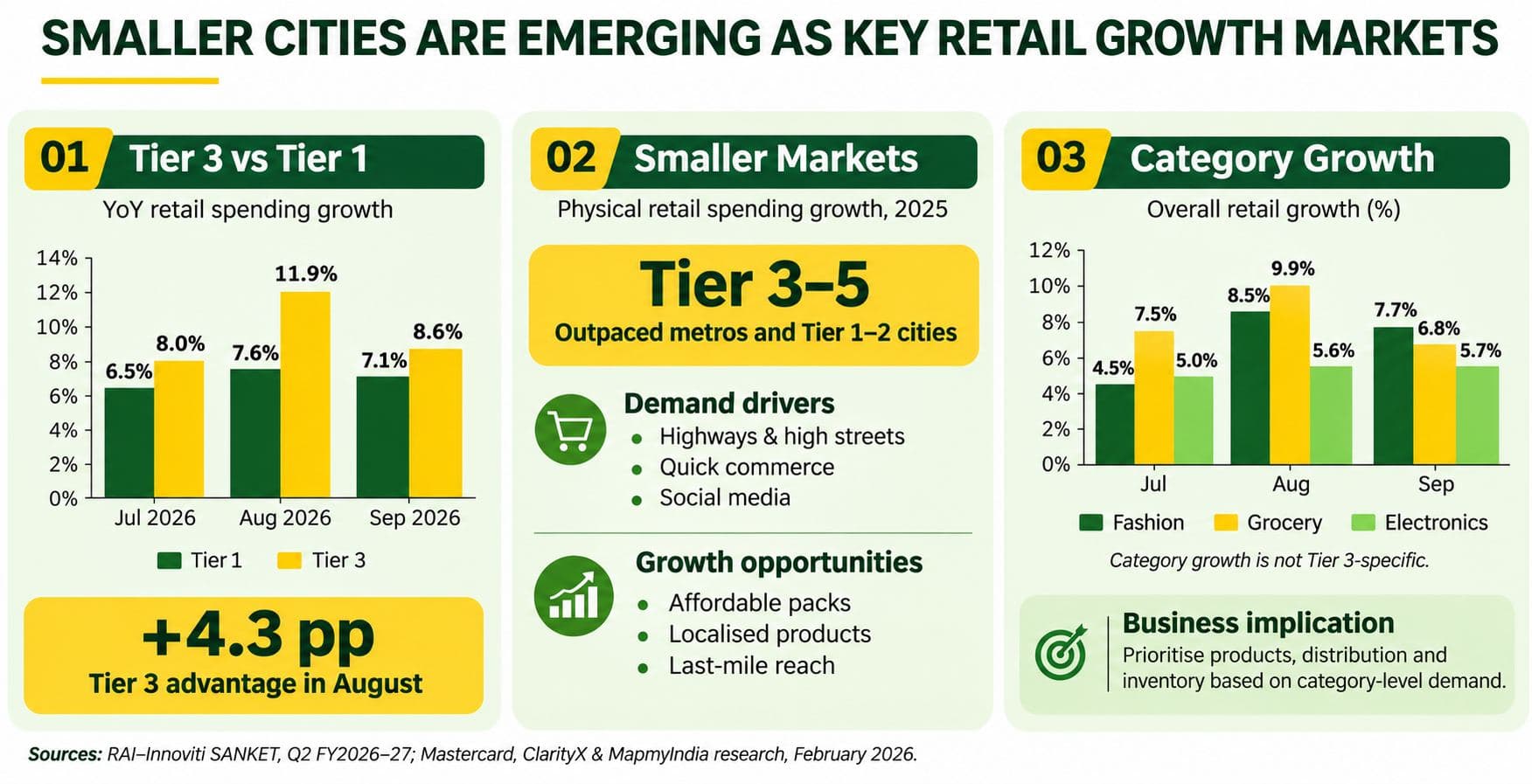
Recent retail spending data suggests that smaller cities are becoming an important source of growth for India's retail sector.
What Does This Mean for Businesses?
The findings point towards an important shift: India's retail opportunity is becoming more geographically distributed. However, entering smaller markets requires a different approach to distribution, product availability and retail execution. Three areas deserve particular attention.
A. Distribution needs to move closer to emerging demand
Many businesses continue to operate distribution networks designed around major cities and established retail markets. This can create gaps when they expand into smaller towns. For example, a brand may have a distributor covering a large geographical area, but its products may not reach all the important retail outlets within that region. Some retailers may receive regular stock, while others may face delays or limited product availability. This creates a gap between market demand and actual sales. Businesses need to understand which towns, localities and retail clusters have the strongest potential and whether their current distribution network can serve them effectively.
B. Product availability and assortment need to match local demand
Consumers across smaller cities should not be treated as one uniform market. Their preferences, spending capacity, shopping habits and brand choices can differ significantly. For example, some markets may offer stronger demand for affordable daily-use products, while others may show interest in premium personal care, fashion or consumer electronics. A brand that distributes the same product range in every market may miss important local opportunities. Businesses should understand:
- Which product categories have stronger local demand?
- Which price points are most suitable?
- Which pack sizes are preferred?
- Which brands and competitors are already available?
- Which products are frequently unavailable at retail outlets? This information can help businesses develop a more suitable product assortment for each market.
C. Retailer relationships become more important
In smaller markets, the retailer often plays an important role in influencing product discovery and purchase decisions. Customers may depend on retailers for product recommendations, availability and information about new brands. Therefore, appointing distributors is only one part of market expansion. Businesses also need to understand retailer expectations around margins, credit periods, stock availability, delivery frequency and promotional support. If retailers do not see sufficient commercial value in stocking a product, they may give greater attention to competing brands. A strong distribution strategy must therefore work for both the company and its retail partners.
Electroyuva's Perspective – Is Your Distribution Network Ready?
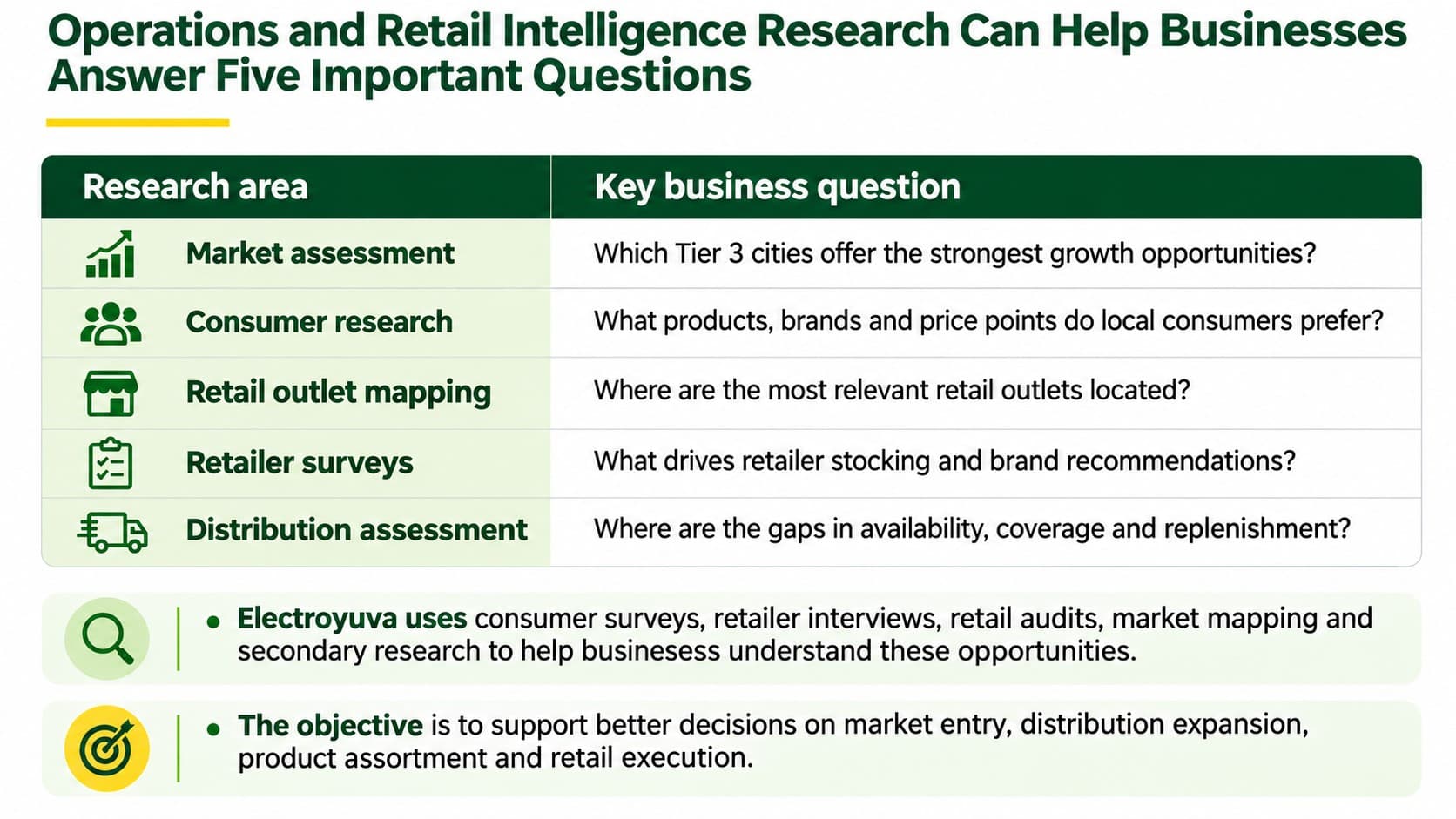
At Electroyuva, we believe businesses should approach Tier 3 expansion through market intelligence rather than simply increasing their geographical presence. The objective should be to identify where demand exists, understand how customers purchase and evaluate whether the business can serve those markets profitably. We recommend four areas of focus.
1. Identify high-potential markets before expansion
Businesses should not select cities only on the basis of population or recent retail growth. They need to evaluate the commercial potential of each market. This includes:
- Local population and household profiles.
- Category-level demand and spending patterns.
- Consumer purchasing power.
- Brand awareness and preferences.
- Competitor presence.
- Retail infrastructure and market accessibility.
A city with a smaller population may offer better opportunities for a particular product category than a larger city with stronger competition. Market prioritization should therefore be based on category-specific demand and business potential.
2. Map retail outlets and distribution gaps
Once priority markets are identified, businesses need to understand the retail landscape. This includes mapping relevant outlets, identifying important retail clusters and assessing current product availability.
Retail audits can help answer important questions:
- How many relevant outlets exist in the market?
- Which competitors are available?
- What is the level of product availability?
- Which outlets have the highest sales potential?
- Where are distribution gaps most visible?
This can help businesses improve outlet coverage and direct their sales efforts towards the right retail locations.
3. Understand retailer economics and expectations
A distribution network cannot grow sustainably if its retailer and distributor economics are not attractive. Businesses should assess retailer margins, distributor incentives, credit expectations, minimum order quantities and delivery requirements. They should also understand why some retailers are willing to stock a brand while others prefer competing products. Retailer interviews and trade surveys can provide useful insights into these decisions. The objective is to build a distribution model that encourages retailers to stock, recommend and regularly replenish products.
4. Strengthen inventory and replenishment planning
Expanding into new markets also increases the complexity of inventory management. Businesses need to ensure that products are available when and where consumers want them. Poor forecasting can result in two problems:
- Stockouts: Products are unavailable when customers want to buy them.
- Overstocking: Retailers and distributors hold more inventory than they can sell. Both situations can affect business performance. Demand forecasting, sales tracking, retailer feedback and regular market assessments can help improve replenishment decisions.
Growth Requires More Than Market Entry
Tier 3 cities are becoming increasingly important to India's retail growth story. The latest RAI–Innoviti findings show that these markets are recording stronger retail spending growth than Tier 1 cities. However, stronger demand does not automatically translate into higher sales for every brand.
Businesses need the right products, suitable pricing, effective distribution, strong retailer relationships and reliable stock availability to capture this opportunity.
At Electroyuva, we believe the next phase of retail growth will not be won simply by entering more cities. It will be won by understanding those markets better and building distribution networks that can serve them effectively. Because market opportunity creates potential, but strong retail execution turns that potential into business growth.
Electroyuva | Consumer Intelligence. Market Understanding. Business Growth.
Sources & References
- Retailers Association of India (RAI) and Innoviti Technologies (October 2026), RAI–Innoviti SANKET Report, Q2 FY2026–27. Covers over 70 million purchases across 2,800+ towns and cities. Read report findings.
- The Economic Times (28 February 2026), India's Tier 3–5 Towns Overtake Metros in Retail Spending Growth. Research by Mastercard, ClarityX and MapmyIndia. Read article.
- India Brand Equity Foundation (IBEF), Indian Retail Industry Analysis. Read industry overview.
Research note: The RAI–Innoviti figures measure like-for-like spending growth at existing stores. Category-level figures are overall market figures and should not be interpreted as Tier 3-specific growth rates. Retail growth does not necessarily indicate the same level of growth in every city, category or brand.